
The way people search for information is changing faster than ever. We’ve moved from traditional search engines to AI-driven answers powered by tools like ChatGPT, Google Gemini, and Microsoft Copilot.
As a digital marketing leader at Annacoder Digitals, I believe one thing is clear:
If your business is not optimized for AI, you’re already behind.
That’s where Generative Engine Optimization (GEO) comes in.
What is Generative Engine Optimization (GEO)?
Generative Engine Optimization (GEO) is the process of optimizing your website and content so it gets featured in AI-generated answers, not just ranked on search engines.
In simple terms:
GEO is the next evolution of SEO.
Instead of only focusing on Google rankings, GEO ensures your content is:
- Understood by AI
- Trusted by AI
- Recommended by AI
Why GEO is Important in 2026
Search behavior is shifting. Today’s users:
- Ask questions directly to AI
- Expect instant, summarized answers
- Rarely click multiple links
This means:
- Traditional SEO alone is not enough
- Visibility inside AI responses is the new competition
Businesses that adapt early will dominate their niche.
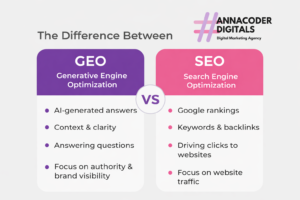
GEO vs SEO: What’s the Difference?
| SEO (Search Engine Optimization) | GEO (Generative Engine Optimization) |
|---|---|
| Focus on Google rankings | Focus on AI-generated answers |
| Keyword-heavy strategy | Context & intent-driven content |
| Backlinks matter most | Trust & clarity matter most |
| Drives website clicks | Drives AI visibility & brand authority |
How Generative Engine Optimization Works
AI engines don’t just crawl content—they:
- Analyze meaning
- Compare multiple sources
- Generate the best possible answer
So your content must be:
✔ Clear
✔ Structured
✔ Helpful
✔ Authoritative
Best Practices for GEO (High-Impact Strategy)
1. Write for Humans First, AI Second
Use simple language. Avoid jargon. Make your content easy to understand.
Example Keywords to include naturally:
- Generative Engine Optimization
- What is GEO in digital marketing
- GEO vs SEO
- AI search optimization
- Future of SEO
2. Use Question-Based Content
AI loves answering questions.
Include sections like:
- What is Generative Engine Optimization?
- How does GEO work?
- Why is GEO important for businesses?
3. Structure Your Content Properly
Use:
- Headings (H1, H2, H3)
- Bullet points
- Short paragraphs
This makes it easier for AI to extract information.
4. Build Authority & Trust
At Annacoder Digitals, we always focus on:
- Real insights
- Practical examples
- Industry expertise
Because AI prefers credible and experience-based content.
5. Create Deep, Valuable Content
Don’t just define—explain and solve problems.
Bad content:
❌ “GEO is the future.”
Good content:
✅ Explain why, how, and give real use cases.
Real Example of GEO in Action
When a user searches:
“Best digital marketing agency for startups”
AI tools may:
- Analyze multiple websites
- Compare services
- Recommend top agencies
If your content is GEO-optimized, your brand (like Annacoder Digitals) can:
✔ Appear in AI answers
✔ Gain trust instantly
✔ Generate high-quality leads
GEO Strategy for Businesses
If you’re a startup or small business, here’s a simple GEO roadmap:
- Create educational blog content
- Answer real customer questions
- Optimize for conversational keywords
- Publish consistently
- Build brand authority online
The Future of Digital Marketing
We are entering an AI-first internet.
Soon:
- Websites won’t just compete for rankings
- They will compete for AI attention
And in that world:
GEO will be more powerful than SEO
At Annacoder Digitals, we’re not just following trends—we’re building the future.
Generative Engine Optimization (GEO) is not optional anymore.
It’s the next big shift in digital marketing.
If your business wants to:
- Stay visible
- Build authority
- Generate consistent leads
Then it’s time to start investing in GEO today.